Revolutionizing Optical Glass Cutting: How Diamond Wire Technology Delivers Crack-Free Precision and Cost Savings
Introduction: The Brittle Material Challenge in Optics Manufacturing
In the precision optics industry, manufacturers face an ongoing battle with brittle material yield improvement. Optical glasses like OHARA, flint, and other specialty compositions present unique machining challenges due to their fragile nature. Traditional cutting methods often result in micro-cracks, edge chipping, and material waste – problems that directly impact production costs and product quality.
This comprehensive guide explores how advanced diamond wire loop cutting machine for optical glass technology is transforming the industry. We’ll examine real-world applications including flint glass cutting | crack-free diamond wire saw solutions, and present a compelling case study: 30% cost saving in OHARA glass cutting that demonstrates the tangible benefits of this innovative approach.
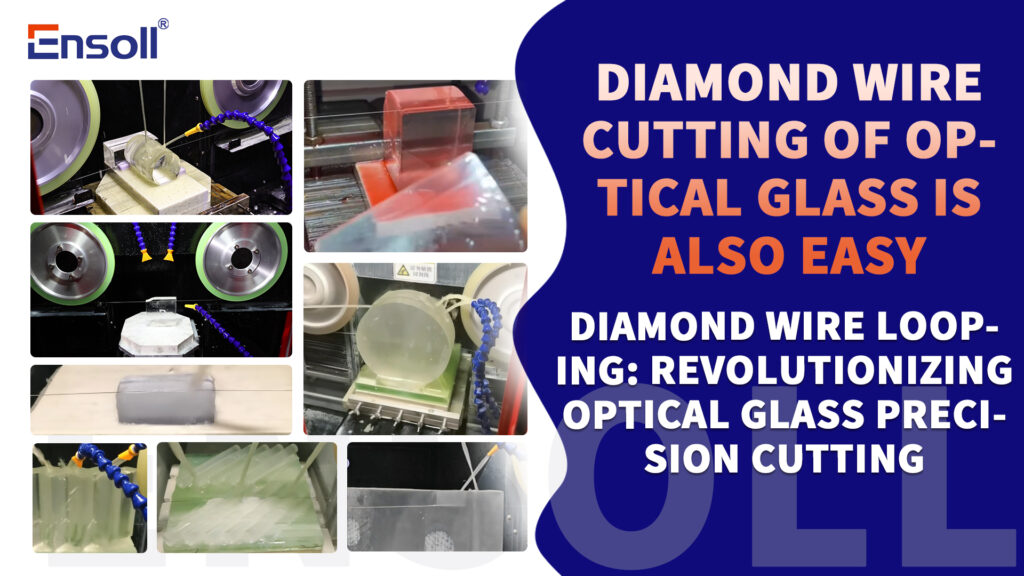
The Science Behind Brittle Material Yield Improvement
Understanding the Fracture Mechanics of Optical Glasses
Optical glasses belong to a class of materials that exhibit brittle fracture behavior under mechanical stress. When conventional cutting methods are applied, these materials tend to:
– Develop subsurface damage (SSD) layers
– Create micro-cracks that propagate over time
– Produce edge chipping that requires additional polishing
– Suffer from thermal stress-induced fractures
The key to brittle material yield improvement lies in minimizing these failure modes through controlled cutting processes that:
- Reduce mechanical stress concentrations
- Eliminate thermal effects
- Maintain consistent cutting forces
- Provide superior edge quality with minimal post-processing
Diamond Wire Technology: A Game-Changer for Optical Glass
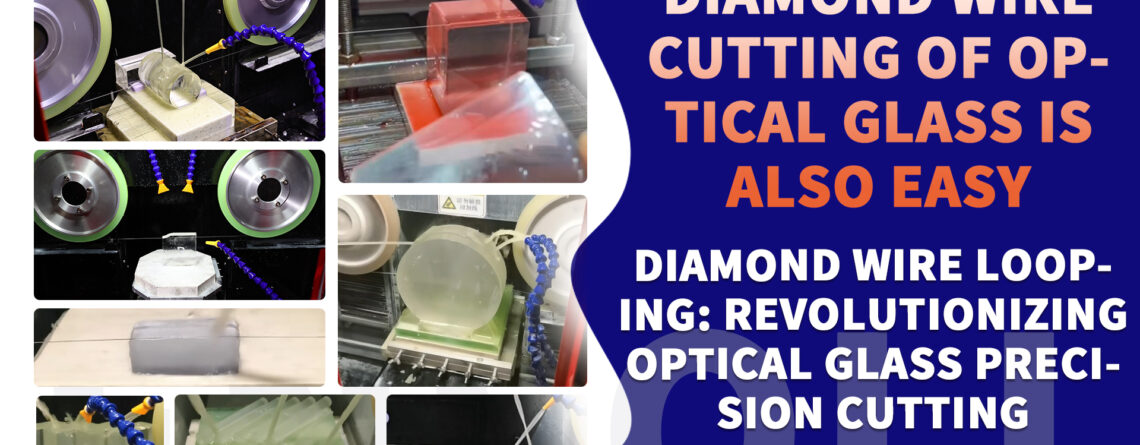
The diamond wire loop cutting machine for optical glass represents a significant advancement over traditional cutting methods. These systems utilize:
– Continuous diamond-impregnated wire loops (typically 0.1-0.3mm diameter)
– Precision tension control systems
– Computer-controlled feed rates
– Multi-axis positioning capabilities
– Advanced cooling/lubrication systems
This combination of features enables flint glass cutting | crack-free diamond wire saw performance that was previously unattainable with conventional methods.
Flint Glass Cutting: Overcoming Unique Challenges with Diamond Wire Saws
Why Flint Glass Presents Special Cutting Difficulties
Flint glass (high refractive index optical glass) contains lead oxide or other heavy metals, which create several machining challenges:
– Increased brittleness compared to crown glasses
– Higher tendency for subsurface damage
– Greater susceptibility to thermal shock
– More pronounced edge chipping effects
Traditional cutting methods often result in:
– Yield losses exceeding 15-20%
– Significant post-processing requirements
– Inconsistent edge quality
The Diamond Wire Solution for Flint Glass
Modern diamond wire loop cutting machine for optical glass systems address these challenges through:
- Cold Cutting Process: Eliminates thermal stress completely
- Micro-Diameter Wires: Reduces kerf loss and cutting forces
- Constant Tension Control: Maintains optimal cutting conditions
- Adaptive Feed Control: Automatically adjusts to material variations
These features combine to deliver flint glass cutting | crack-free diamond wire saw results with:
– Edge quality meeting ISO 10110-7 standards
– Surface roughness < 0.5μm Ra
– Subsurface damage depth < 2μm
– Cutting tolerances within ±5μm
Case Study: 30% Cost Saving in OHARA Glass Cutting
Background: The Manufacturer’s Challenge
A leading optical components manufacturer producing precision lenses from OHARA S-BSL7 glass faced:
– 22% material yield loss from cutting operations
– High polishing costs to remove subsurface damage
– 15% rejection rate due to edge defects
– Frequent machine downtime for blade changes
Solution:
Switching to a diamond wire saw cutting machine resulted in:
✔ 30% reduction in material waste
✔ 50% less polishing required
✔ Longer tool life – Fewer wire replacements
Results:
- Overall cost savings: 30%
- Improved yield rates
- Higher-quality edges meeting ISO 10110 standards
Why Diamond Wire Cutting Outperforms Traditional Methods
| Factor | Diamond Wire Saw | Traditional Blade |
| Edge Quality | Crack-free, smooth | Often requires polishing |
| Material Waste | Minimal kerf loss | Higher kerf loss |
| Tool Life | Long-lasting wire | Frequent blade changes |
| Thermal Impact | None (cold cutting) | Risk of heat cracks |
Conclusion
The diamond wire loop cutting machine for optical glass is revolutionizing the industry by enabling:
Brittle material yield improvement
Flint glass cutting | crack-free diamond wire saw precision
Substantial cost savings (as shown in the OHARA case study)
For manufacturers seeking higher efficiency and lower waste, diamond wire technology is the future of optical glass machining.