
Precision Contour Cutting of Magnet Materials with Diamond Wire Saw Technolog
1. The Challenge of Cutting Complex Magnet Shapes
Magnetic materials like NdFeB, SmCo, and ferrites are essential for motors, sensors, and medical devices. However, their brittleness and high hardness make traditional cutting methods (grinding, laser, EDM) problematic:
– Grinding wheels cause micro-cracks and edge chipping
– Laser cutting creates heat-affected zones (HAZ) that degrade magnetic properties
– EDM only works on conductive materials (excluding ferrites)
Contour cutting (complex shapes like arcs, slots, or trapezoids) demands even higher precision. This is where diamond wire saw cutting machines excel.
2. Why Diamond Wire Saw Cutting is Ideal for Contour Cutting
How It Works
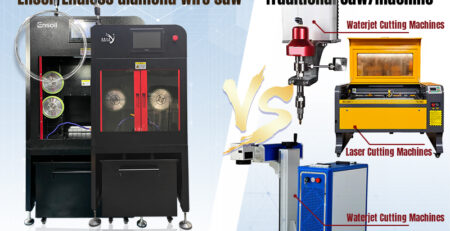
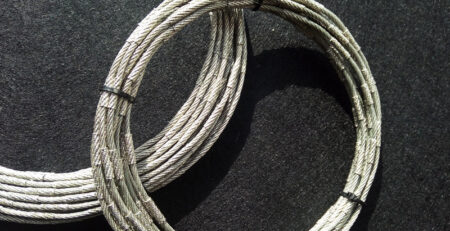
A diamond wire saw cutting machine uses a thin, diamond-coated wire (Ø0.05–0.3mm) in a continuous loop, guided by CNC for precise contour cutting.
Key Advantages Over Conventional Methods
✔ No Thermal Damage – Coolant keeps temperatures <40°C, preserving magnetic flux
✔ Chip-Free Edges – Ra <0.5μm surface finish (vs. 3–5μm with grinding)
✔ High Precision – ±0.02mm tolerances for intricate geometries
✔ Material Savings – Kerf width just 0.1–0.2mm (vs. 0.8–1.5mm with abrasive wheels)
Industries Using This Technology
– EV Motors – Trapezoidal NdFeB segments for higher efficiency
– Medical Devices – SmCo implants with smooth, burr-free edges
– Consumer Electronics – Miniature ferrite cores for inductors
Key Advantages Over Conventional Methods
✔ No Thermal Damage – Coolant keeps temperatures <40°C, preserving magnetic flux
✔ Chip-Free Edges – Ra <0.5μm surface finish (vs. 3–5μm with grinding)
✔ High Precision – ±0.02mm tolerances for intricate geometries
✔ Material Savings – Kerf width just 0.1–0.2mm (vs. 0.8–1.5mm with abrasive wheels)
Industries Using This Technology
– EV Motors – Trapezoidal NdFeB segments for higher efficiency
– Medical Devices – SmCo implants with smooth, burr-free edges
– Consumer Electronics – Miniature ferrite cores for inductors
3. Optimizing Diamond Wire Cutting for Different Magnet Types
A. Cutting NdFeB Magnets
– Wire Type: Electroplated diamond wire (mesh #200–400)
– Speed: 20–50m/min for best finish
– Coolant: Oil-based for heat dissipation
Case Study: An EV motor manufacturer reduced waste by 22% when switching from grinding to diamond wire.
B. Processing Ferrite Magnets
– Wire Type: Resin-bonded diamond for longer life
– Speed: 10–30m/min (slower = better edge quality)
– Challenge: Avoid cracks in large-diameter cuts (>100mm)
- SmCo & Other Rare-Earth Magnets
– Requires ultra-fine wire (Ø0.05mm) for minimal material loss
– Multi-wire setups cut 50+ pieces simultaneously
4. Choosing the Right Diamond Wire Saw Machine
Critical Features
– CNC Control – For complex contours (e.g., motor pole shapes)
– Wire Tension System – Maintains ±1N consistency
– Coolant Filtration – Prevents debris buildup
Cost Analysis
| Method | Precision | Speed | Cost/cm |
| Diamond Wire | ±0.02mm | 30m/min | $0.15 |
| Laser | ±0.1mm | 10m/min | $0.35 |
| Grinding | ±0.05mm | 5m/min | $0.25 |
ROI: Most manufacturers recoup costs in 6–12 months via material savings.
5. Future Trends in Magnet Cutting
– AI Optimization: Machine learning adjusts wire speed/tension in real time
– Thinner Wires (Ø0.03mm) for <0.1mm kerf loss
– Hybrid Systems: Laser pre-cutting + diamond wire finishing
Conclusion: For precision contour cutting of magnets, diamond wire saw machines outperform traditional methods in quality, speed, and cost efficiency.
Need a Quote? [Contact Us] for a free cutting sample!