CNC Diamond Wire Loop: Precision Cutting Guide
In the world of precision cutting, few technologies have sparked as much transformation as the diamond wire loop cutting machine. Unlike traditional saws that rely on toothed blades or abrasive discs, this innovative tool uses a continuous loop of wire embedded with diamond grit to slice through the hardest materials on Earth.
But what exactly is a diamond wire loop cutting machine? How does it work? And why are manufacturers across industries—from semiconductors to aerospace—rapidly adopting this technology?
This comprehensive guide answers all those questions and more. Whether you’re a seasoned manufacturing engineer or new to precision cutting, you’ll discover why diamond wire loop technology is redefining what’s possible in material processing.
What Is a Diamond Wire Loop Cutting Machine? A Clear Definition
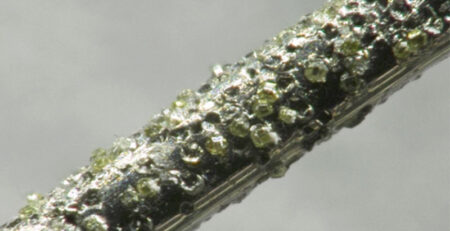
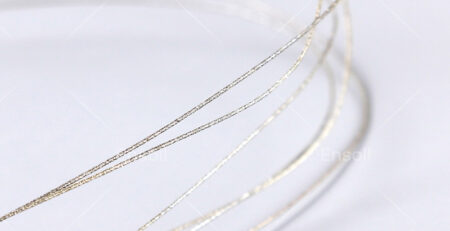
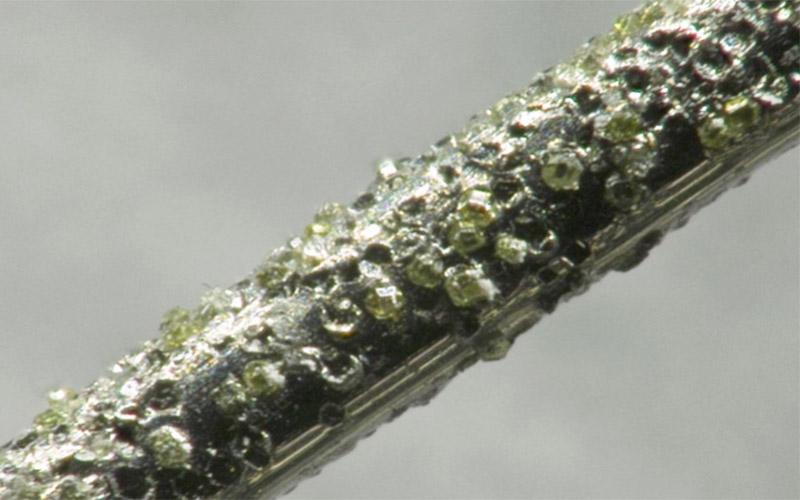
A diamond wire loop cutting machine (also known as an endless diamond wire saw) is a precision cutting system that uses a continuous, looped wire coated with industrial diamond particles to slice through hard, brittle, or abrasive materials.
The “diamond wire” refers to a high-strength steel wire—typically 0.2 mm to 2.0 mm in diameter—that has been electroplated or resin-bonded with synthetic diamond grit. The “loop” means the wire ends are welded together to form a seamless, continuous ring. This endless design allows the wire to rotate in a single direction at extremely high speeds, unlike traditional reciprocating wire saws that move back and forth.
Think of it as a miniature diamond-studded conveyor belt for cutting. The result? Clean, precise cuts with minimal material waste, no edge chipping, and exceptional surface quality—even on materials traditionally considered “uncuttable.”
How Does a Diamond Wire Loop Cutting Machine Work?
Understanding the working principle of a diamond wire loop cutter explains why it outperforms conventional methods. Here’s the step-by-step process:
Step 1: Wire Loop Installation
A diamond wire loop of the appropriate diameter and grit size is mounted onto a set of pulleys or guide wheels. The loop is tensioned to precise specifications—tight enough to maintain straight cutting but flexible enough to navigate complex contours.
Step 2: High-Speed Rotation
The drive system rotates the wire loop at speeds ranging from 4mm/min —significantly faster than reciprocating wire saws. Because the loop is endless and moves continuously in one direction, there is no deceleration or directional change, eliminating the “jerk” that can cause material damage.
Step 3: Material Contact and Grinding
The rotating diamond wire is brought into contact with the workpiece. Each diamond particle acts as a microscopic cutting tooth, grinding away material through a combination of abrasion and micro-fracturing.
Unlike traditional blades that shear or tear material, the diamond wire grinds its way through. This distinction is crucial: grinding distributes mechanical stress evenly, while shearing concentrates stress at a single point.
Step 4: Cooling and Swarf Removal
Most diamond wire loop cutting systems incorporate a coolant delivery system, typically using water or a water-based solution. The coolant serves three purposes:
– Cools the cutting zone, preventing thermal damage to the workpiece
– Flushes away cutting debris (swarf), preventing clogging
– Lubricates the wire, extending its working life
Step 5: Precision Motion Control
The workpiece or the cutting head moves along a programmed path under CNC (Computer Numerical Control). This allows for:
– Straight cuts
– Curved contours
– Special-shaped (non-linear) cutting
– Tapered or angled cuts
Key Components of a Diamond Wire Loop Cutting Machine
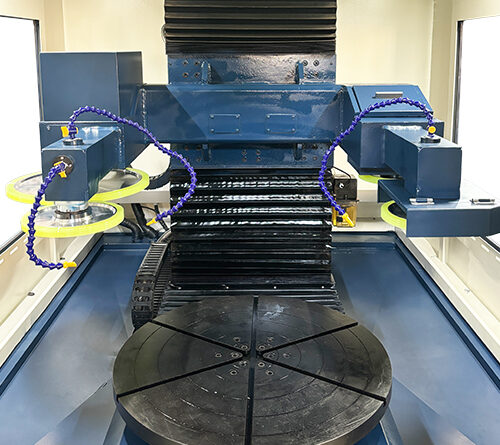
Modern diamond wire loop cutting systems integrate several sophisticated components:
| Component | Function |
| Diamond Wire Loop | The cutting tool—a continuous loop of steel wire electroplated with diamond grit |
| Drive Pulleys | Rotate the wire loop at high speeds |
| Tension Control System | Maintains optimal wire tension for straight, accurate cuts |
| CNC Controller | Interprets G-code and coordinates cutting path |
| Worktable (X-Y-Z Axis) | Positions the workpiece for precise cutting |
| Rotary Axis (Optional) | Enables cutting of cylindrical or tubular materials |
| Coolant System | Delivers cooling fluid to the cutting zone |
| Swarf Filtration | Removes cutting debris from coolant for recirculation |
Types of Diamond Wire Loop Cutting Machines.
Diamond wire loop technology has evolved to serve different applications:
1.Single-Loop Precision Cutters
Designed for laboratory and small-scale production, these machines use a single small-diameter wire loop (typically 0.2–0.5 mm). They excel at cutting:
– Semiconductor wafers (silicon, silicon carbide, gallium arsenide)
– Optical glass and crystals
– Ceramic substrates
– Circuit boards
2. Multi-Loop Production Saws
For high-volume cutting of large workpieces, these machines use multiple parallel wire loops to slice many pieces simultaneously. Common in:
– Photovoltaic (solar) wafer production
– LED substrate manufacturing
– Quartz and sapphire slicing
3. Special-Shaped Cutting Systems
These CNC-controlled machines are optimized for cutting non-linear, complex shapes. They feature:
– Multi-axis motion (X, Y, Z, and rotary axes)
– Ability to cut circles, arcs, and custom contours
– Applications in automotive, aerospace, and medical device manufacturing
Why Use a Diamond Wire Loop Cutting Machine?
Traditional cutting methods—bandsaws, abrasive wheels, laser cutters—all have limitations when it comes to hard, brittle materials. Diamond wire loop technology offers several transformative advantages.
1. Minimal Material Waste (Thin Kerf)
The “kerf”—the width of material removed as cut—is remarkably small with diamond wire. A typical diamond wire loop has a diameter of just 0.2–0.6 mm, compared to 1.5–3.0 mm for a conventional abrasive blade.
The benefit: You get more usable product from expensive raw materials. For industries working with silicon carbide wafers ($500+ each) or sapphire crystals, this waste reduction translates directly to higher profitability.
2. No Edge Chipping or Breakage
Brittle materials like glass, ceramics, and semiconductors are notorious for chipping at the cut exit point. Traditional blades concentrate mechanical stress, causing fractures.
The diamond wire advantage: Because the wire uses a high-speed grinding action rather than a shearing action, stress is distributed evenly across the cutting zone. The result is clean, smooth edges with zero chipping—even at cut entry and exit points.
3. Superior Surface Finish
Diamond wire loop cutting produces surface finishes measured in microns of Ra (roughness average) —often Ra 0.4–1.6 µm. This “near-polished” surface significantly reduces or eliminates the need for subsequent grinding and polishing steps.
4. Cut Any Hardness
Traditional cutting requires the tool to be harder than the workpiece. Diamond wire has no such limitation. Diamond is the hardest known material (10 on the Mohs scale), capable of cutting:
– Silicon carbide (9.5 Mohs)
– Tungsten carbide (9.0 Mohs)
– Sapphire (9.0 Mohs)
– Hardened steel (8.0 Mohs)
– Quartz, glass, and ceramics
5. Minimal Heat-Affected Zone (HAZ)
Unlike laser or plasma cutting, which can create a significant heat-affected zone that alters material properties, diamond wire cutting generates minimal heat. The combination of:
– High-speed rotation (carrying heat away)
– Continuous coolant flow
– Discrete diamond contact points
…means the workpiece stays cool to the touch. This is critical for temperature-sensitive materials like optical glass and semiconductor crystals.
6. Complex Shapes and Contours
CNC-controlled diamond wire loop machines can cut:
– Straight lines
– Circles and arcs
– Custom 2D profiles
– Tapered shapes (by tilting the workpiece or wire guide)
Some advanced systems even offer 3D cutting by combining X, Y, Z, and rotary axes.
7. Environmentally Friendly
Compared to slurry-based cutting systems (which use loose abrasive particles suspended in oil or glycol), diamond wire loop cutting is significantly greener:
– Water-based coolant instead of oil
– No hazardous slurry waste requiring disposal
– Lower energy consumption per cut
– Recyclable steel wire (after diamond grit wears)
Limitations to Consider
Diamond wire loop cutting isn’t the right choice for every application. Here are its main limitations:
Not for Ductile Materials
Soft, ductile materials like aluminum, copper, or mild steel can clog the diamond grit. These materials tend to smear rather than fracture, loading up the wire and reducing cutting efficiency.
Slower Than Abrasive Wheels for Thick Sections
For very thick workpieces (over 200 mm), a diamond wire loop cuts more slowly than a large abrasive wheel. However, the tradeoff is dramatically better surface quality and no chipping.
Wire Loop is a Consumable
The diamond coating eventually wears out. However, modern electroplated diamond wires offer long working life—often hours of continuous cutting—and are relatively inexpensive to replace.
Initial Equipment Investment
Quality diamond wire loop cutting machines represent a significant capital investment. Entry-level single-loop systems start around $10,000, while multi-axis CNC production systems can exceed $150,000.
How to Choose the Right Diamond Wire Loop Cutting Machine
If you’re considering adding this technology to your manufacturing line, here are key factors to evaluate:
1. Material Type and Hardness
– Brittle materials (glass, ceramics, silicon) → Diamond wire loop is ideal
– Ductile metals (aluminum, copper) → Consider alternative methods
2. Required Precision and Surface Finish
– Ra < 1.6 µm required → Diamond wire loop delivers
– Tolerances < ±0.01 mm → High-end CNC system needed
3. Workpiece Size and Shape
– Small parts (< 300 mm) → Single-loop benchtop system
– Large blocks (> 300 mm) → Multi-loop or gantry-style system
– Complex contours → Multi-axis CNC with rotary capability
4. Production Volume
– R&D / prototyping → Basic single-loop system
– Low-volume production → Semi-automated single-loop
– High-volume production → Multi-loop or fully automated system
5. Wire Diameter Range
– Micro-cutting (< 0.3 mm) → Fine wire capability required
– General purpose (0.3–0.6 mm) → Most common range
– Heavy cutting (> 0.6 mm) → Industrial-grade system
Conclusion
So, what is a diamond wire loop cutting machine? It’s a precision cutting system that uses a continuous loop of diamond-embedded wire to slice through hard, brittle materials with unmatched accuracy, minimal waste, and zero edge chipping.
From the silicon carbide wafers powering next-generation electric vehicles to the sapphire crystals enabling brighter LEDs, diamond wire loop technology works silently behind the scenes—enabling the advanced manufacturing that defines our modern world.
Is diamond wire loop cutting right for your application? If you’re working with glass, ceramics, semiconductors, composites, or any material that chips, cracks, or wears out traditional blades—the answer is almos